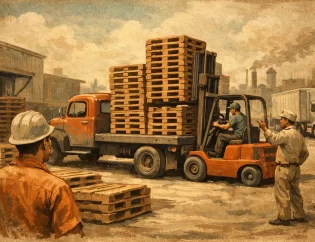

If your Chicago warehouse is clearing out broken pallets, your Dallas site is short on usable inventory, and your Phoenix location is waiting on a pickup update, the real problem is not pallets. It is visibility. Pallet tracking software for multiple locations gives operations teams one place to see what is moving, what is piling up, and what needs action before costs grow.
For multi-site businesses, pallet activity rarely stays simple for long. One facility may generate reusable pallets that still have resale value. Another may need paid removal because the material is damaged or mixed. A third may be buying replacement pallets on a regular schedule. When each site handles those issues differently, reporting gets messy, local vendors vary in service quality, and corporate teams lose the ability to manage pallet costs as a system.
Why pallet tracking software for multiple locations matters
At a single site, pallet management can often be handled with spreadsheets, email chains, and a dependable local contact. Across five, 20, or 100 locations, that approach starts to break down. Data is delayed. Pickup requests get missed. Surplus pallets sit too long. Procurement and operations teams end up spending time chasing updates instead of managing flow.
The software matters because it turns pallet activity into something measurable and centralized. Instead of asking each site for status, a business can review pickups, removals, purchases, and recovery activity in one system. That shift sounds simple, but it changes decision-making. You can compare locations, spot avoidable waste hauling costs, and identify where reusable pallets are creating value rather than being discarded.
It also supports accountability. When every transaction is tied to a location, date, volume, and service type, it becomes easier to understand who requested what, what was completed, and how often each site needs support. That is useful for daily operations, but it also helps during budgeting, vendor reviews, and internal sustainability reporting.
What good multi-location pallet tracking should actually do
Not every system that claims to track pallets solves the real operating problem. Some tools are designed mainly for internal warehouse asset control. Others are built for broad supply chain visibility but do not fit the day-to-day realities of pallet pickup, recycling, and resale.
For businesses managing pallet accumulation and supply across several sites, the most useful software starts with location-level visibility. Each facility should be easy to identify, with a clear record of service history, current requests, and transaction volume. A corporate team should be able to look across all sites without losing the detail needed to manage exceptions.
Pickup coordination is another core function. If a site has excess pallets, the software should make it easy to request service without a long back-and-forth. Just as important, the status of that request should remain visible. Teams need to know whether a pickup is pending, scheduled, completed, or delayed. That reduces follow-up calls and helps facilities plan around dock space.
The best platforms also reflect the fact that pallets do not all have the same value. Some loads are clean, sorted, and reusable. Some are mixed or damaged. Some may qualify for payment, while others involve removal fees. Software that captures pallet type, condition, and volume gives a more accurate picture of cost and recovery potential. Without that detail, reporting can look organized while still hiding the financial reality.
Reporting should be practical, not decorative. Operations leaders need to see trends by site, service type, and time period. Procurement teams may want to compare purchase activity. Sustainability teams may need evidence of recycling and recovery. The right system supports those needs without making staff learn a complicated platform.
The operational payoff
The biggest benefit of pallet tracking software for multiple locations is not technology for its own sake. It is fewer moving parts for your team.
When information is centralized, local facilities spend less time searching for vendors, confirming schedules, and explaining site history repeatedly. Corporate teams get a cleaner view of service activity across the business. Finance has better documentation behind charges and credits. Procurement can see whether pallet purchases align with demand or whether recoverable supply is being missed.
There is a cost benefit as well, although it depends on your operating model. Some businesses reduce hauling expenses because usable pallets are separated and recovered instead of going into general waste streams. Others improve resale recovery by identifying which locations consistently generate reusable inventory. In some cases, the gain is simply administrative efficiency. If your staff is handling pallet issues through scattered phone calls and email threads, reducing that burden has value too.
Service consistency is another advantage. Multi-site businesses often deal with a patchwork of local providers. One market may perform well while another creates delays, limited reporting, or unclear pricing. Software alone will not solve poor service, but paired with a centralized provider model, it helps standardize expectations across locations.
Where businesses run into trouble
Many companies assume tracking starts with software selection. In practice, the harder issue is process alignment.
If every location uses different pallet categories, measures volume differently, or requests pickups in its own format, the data will be inconsistent from the start. That makes reporting less useful. Before any software can help, businesses need a simple operating standard. Sites should know how to identify reusable versus scrap pallets, when to request service, and what information needs to be entered each time.
There is also a trade-off between control and flexibility. A highly standardized system gives better reporting, but some locations have unique dock schedules, volume swings, or pallet mixes that require local adjustments. The best setup usually combines a common framework with enough flexibility to reflect real site conditions.
Another issue is separating internal pallet tracking from service tracking. If your company needs to manage pallet assets inside the building, that may require a different tool than the one used to coordinate pickups, resale, recycling, and supply across outside partners. Some businesses need both. Others get more value from focusing on transaction visibility rather than trying to track every pallet individually.
Choosing software and service together
For most businesses with multiple locations, pallet tracking works best when the system is connected to the service model behind it.
That matters because pallet management is not just a reporting exercise. Sites need pickups scheduled. Surplus needs to be evaluated. Reusable inventory may need to be bought back or remarketed. Damaged material may require paid removal. Replacement pallets may need to be supplied. If the software sits apart from those actions, your team still ends up coordinating too much manually.
A better approach is to look for a partner that combines online visibility with real operational support. That means one account structure across locations, straightforward request handling, and reporting that reflects actual services completed. It should also mean a model that adapts to pallet type, volume, and condition rather than forcing every location into the same outcome.
For example, one site may generate pallets that can be resold, another may only need recycling pickup, and another may buy pallets regularly. A centralized system should allow all of that to live under one program. That gives decision-makers a clearer view of the whole picture instead of separate local arrangements that are difficult to compare.
For companies operating across regions, national coverage is part of the software conversation even if it sounds like a service issue. A platform is only useful if locations can actually receive comparable support. If half your sites are outside the provider’s workable range, the reporting will always be incomplete.
What to ask before you commit
When evaluating pallet tracking software for multiple locations, focus less on feature volume and more on operational fit. Ask how locations are organized inside the system and how easy it is to view activity by site or across the whole account. Ask what information is captured for each pickup, removal, purchase, or recovery transaction. Ask how exceptions are handled when material condition changes what a load is worth.
It is also worth asking who will use the system day to day. A plant manager may need a simple request process. A regional operations leader may care about trend reporting. Finance may need transaction records. If the platform tries to serve everyone with the same screen and workflow, it can become harder to use than the manual process it replaced.
Finally, look at responsiveness. A clean dashboard is helpful, but it does not clear a yard or free up dock space. If service execution is slow, the software will only document the delay. The strongest programs combine visibility with reliable follow-through.
Pallet Pickup is built around that model: one provider, one tracking system, and one less concern for businesses managing pallet activity across multiple facilities. When pallet removal, recycling, resale, and supply are handled through a centralized program, your team gets clearer oversight without adding internal complexity.
The right system should make pallet management feel smaller than it is. When every location can be seen, supported, and measured in one place, operational decisions get easier and waste has fewer places to hide.