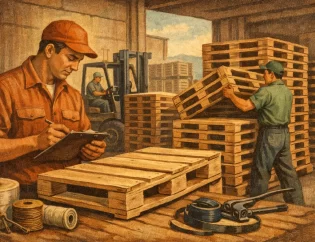
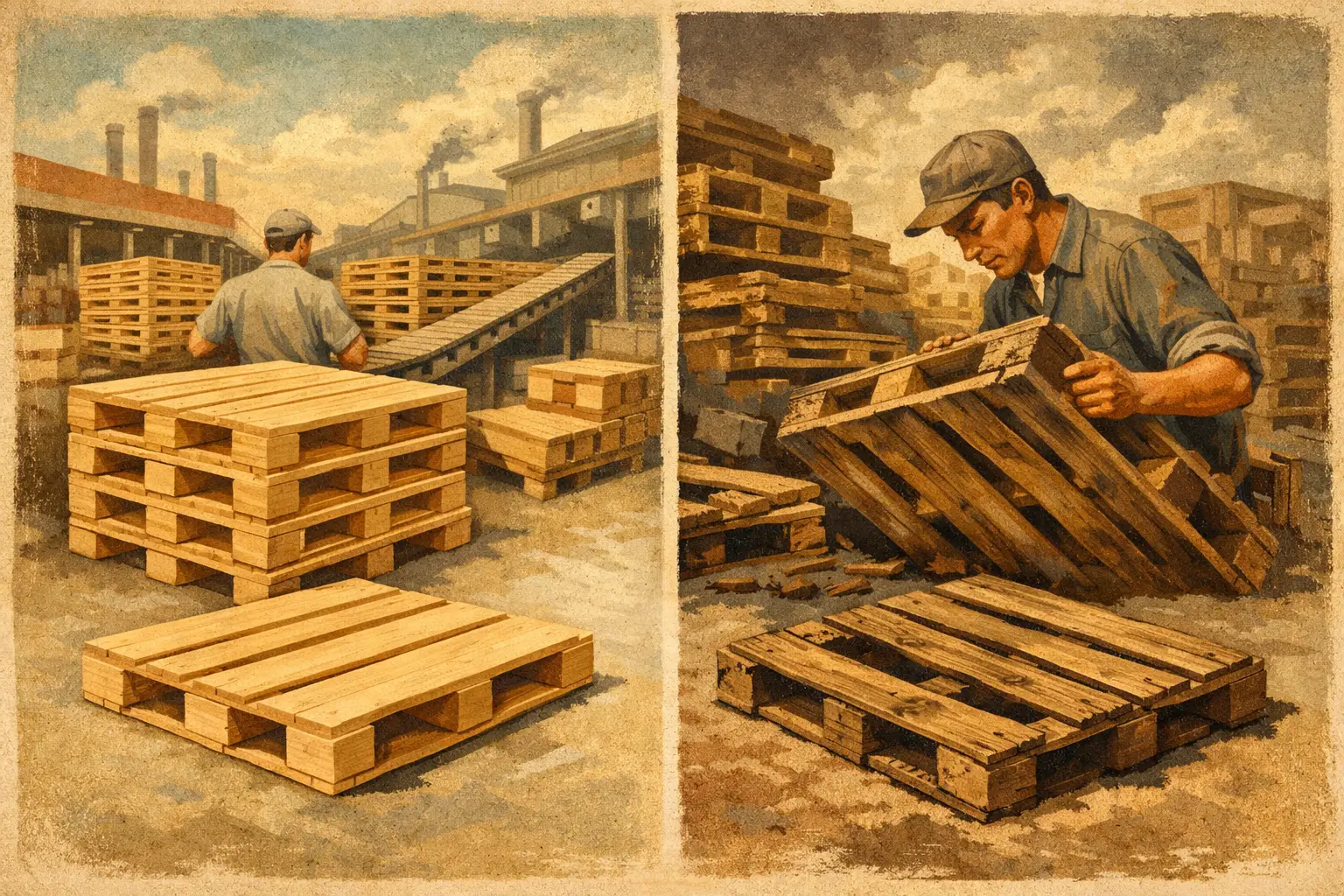
A trailer arriving with the wrong pallets can create more disruption than most teams expect. Loads may need to be reworked, customer specifications may be missed, and usable inventory can pile up in the yard. The decision between new pallets versus recycled pallets is not simply a purchasing choice. It affects freight protection, warehouse flow, cost control, waste handling, and the reliability of your pallet supply.
For many businesses, recycled pallets are the practical default. For others, new pallets are necessary to meet precise specifications or demanding handling conditions. The right choice depends on what the pallet needs to do after it leaves your dock, not on a blanket assumption that one option is always better.
New Pallets Versus Recycled: The Core Difference
New pallets are built from new lumber to a defined design. They offer a consistent appearance, dimensions, and construction because every unit begins with the same materials and production process. Businesses often choose them when pallet specifications are strict, product loads are high-value, or a customer requires new wood packaging.
Recycled pallets are recovered from commercial circulation, inspected, repaired where needed, and returned to service. Their value comes from extending the life of sound pallet material that would otherwise become waste. A properly sorted recycled pallet can be a dependable platform for many warehouse, distribution, and transportation applications.
The key distinction is not that new pallets are automatically strong and recycled pallets are automatically unreliable. Quality depends on the pallet design, its condition, the repair standard, and whether it matches the load and handling environment. A light-duty recycled pallet may be a poor fit for a dense export load, just as an overbuilt new pallet may be an unnecessary expense for a short, local shipment.
When New Pallets Make Business Sense
New pallets are a strong option when consistency is a non-negotiable part of the operation. If automated equipment relies on exact entry points, deck spacing, or pallet height, variations can lead to jams, slowdowns, and avoidable labor. A standardized new pallet program helps reduce those variables.
They are also useful for one-way shipments where pallets are unlikely to return, especially when the product value is high and the shipment will travel through several handling points. A new pallet provides a known starting condition, which can be helpful when setting packaging requirements and managing risk.
Some customers, industries, or export programs may require specific pallet types, heat treatment, stamps, or clean appearance standards. In these cases, the specification should lead the decision. Procurement teams should confirm requirements before ordering rather than assuming any wood pallet will be accepted.
New pallets can also be the better choice when a business needs a custom footprint or design. Unusual product dimensions, concentrated load points, rack storage, and specialized material handling often call for a pallet engineered around the application. That higher upfront cost can be justified when it prevents product damage or repeated operational issues.
Where Recycled Pallets Deliver More Value
Recycled pallets are often the most cost-effective choice for standard warehouse and distribution needs. They are commonly available in established sizes and grades, making them suitable for routine shipments, internal transfers, general storage, and many outbound loads.
The financial benefit is straightforward: a recycled pallet usually costs less than a comparable new pallet because usable lumber and components are recovered instead of produced from scratch. For operations moving hundreds or thousands of pallets, the unit-cost difference can have a meaningful impact on the shipping budget.
The sustainability benefit is equally practical. Reusing pallets keeps serviceable wood in circulation longer, reduces demand for new lumber, and helps divert damaged materials from disposal. For businesses tracking waste reduction or environmental performance, pallet recovery creates a measurable operational story rather than a broad sustainability claim.
Recycled inventory can also support a more flexible supply strategy. A business that generates surplus pallets at one facility may be able to recover value from reusable units while sourcing recycled pallets for another location. That approach turns pallet management into a controlled material flow instead of a recurring disposal problem.
Cost Is More Than the Purchase Price
Comparing only the price per pallet can lead to the wrong decision. The better calculation includes how long the pallet performs, how often it causes handling problems, what happens at the end of its use, and how much staff time is required to manage excess inventory.
A new pallet may cost more initially but reduce risk for a sensitive shipment. A recycled pallet may offer better overall value for a routine load that does not need a custom design or pristine appearance. The relevant question is the cost per successful shipment, not simply the cost per unit purchased.
Pallet accumulation should be part of that calculation. Broken or unwanted pallets take up staging space, create safety concerns, and can lead to waste-hauling charges when there is no recovery plan. Regular pickup and sorting can help separate reusable pallets from material that needs recycling, reducing clutter while capturing value where possible.
Multi-site businesses should also consider administration. Different local vendors, inconsistent pricing, and limited transaction records make it difficult to understand what each location is buying, selling, or discarding. A centralized pallet management program gives operations and procurement teams clearer visibility across facilities.
Match the Pallet to the Load and Handling Conditions
Before selecting new or recycled pallets, assess the work the pallet will perform. Load weight matters, but it is only one part of the picture. A pallet supporting a uniformly distributed boxed load has different requirements than one carrying drums, bagged material, machinery, or products with concentrated weight points.
Consider whether pallets will be moved by forklift, pallet jack, conveyor, or automated storage equipment. Fork entry requirements, bottom-board configuration, and deck-board spacing can all affect performance. A pallet that works well in one building may not work in another if the material handling equipment differs.
Storage conditions matter too. Outdoor staging, long dwell times, humid environments, and repeated transportation cycles can place more stress on wood pallets. In those situations, a higher-grade recycled pallet or a purpose-built new pallet may be appropriate. The decision should be based on the actual operating environment, not a generic pallet category.
Businesses should also account for destination requirements. If pallets are going to retailers, manufacturers, export customers, or a closed-loop network, confirm the accepted specifications in advance. Sending the wrong pallet can create chargebacks, rejection risk, or unnecessary return freight.
Quality Control Determines Recycled Pallet Performance
The phrase “recycled pallet” covers a wide range of conditions. A reliable supply program sorts pallets by size, construction, repair needs, and grade so that buyers receive inventory appropriate for the intended use. This is where a capable pallet partner matters.
Sound recycled pallets should be inspected for broken boards, missing components, protruding nails, structural damage, contamination, and other issues that could affect safe handling. Repairs should restore functional performance, not merely improve appearance. The pallet also needs to be matched to the agreed grade and specification.
Clear communication helps prevent problems. A supplier should understand the pallet size, expected volume, load type, required condition, delivery schedule, and whether the pallets will be used for storage, shipment, or both. The more specific the application, the more accurately the supply can be managed.
For recurring demand, consistency improves when purchasing, pickup, and recycling are coordinated. Instead of treating used pallets as waste and new supply as a separate problem, businesses can manage both sides through one operating plan.
Build a Pallet Program Around Your Actual Needs
The most efficient pallet programs do not force every location into one answer. A distribution center may need recycled pallets for everyday outbound orders while using new pallets for key accounts or specialized loads. A manufacturer may sell surplus standard pallets, arrange pickup for damaged material, and buy replacement inventory through the same provider.
Start by reviewing the pallet types moving through each facility and identifying where volume is being lost to disposal, storage congestion, or inconsistent supply. Then establish practical standards: which sizes are accepted, what condition is required, how often pickups are needed, and when new pallets are necessary.
Pallet Pickup supports this type of coordinated approach with pallet pickup, recycling, resale, and supply management designed around commercial volume. For businesses with multiple facilities, centralized tracking can reduce the work of reconciling activity across separate locations.
The best choice is the one that protects your product, fits your equipment, meets customer requirements, and keeps usable material in circulation. When pallet supply and pallet removal are managed together, they become one less concern for your business.