
When pallet stacks start taking over dock space, the problem is rarely just cleanup. It becomes a scheduling issue, a safety issue, a cost issue, and for multi-site operations, a visibility issue. A national pallet recycling service solves that at the operational level by giving businesses one provider to manage pickup, recycling, resale, and reporting across locations.
For companies moving product every day, pallet removal cannot sit on a back-burner list until someone has time to call around. Local vendors may work for one facility, but they often create inconsistency when your footprint grows. Different pricing, different response times, and different standards can turn a simple support task into another process your team has to manage.
Why a national pallet recycling service matters
The real value of a national pallet recycling service is control. Instead of relying on a patchwork of local haulers, recyclers, and pallet buyers, your business works through one system and one service model. That means less internal coordination, fewer vendor handoffs, and a clearer view of what is happening across your operation.
This matters most for warehouses, manufacturers, distributors, retailers, and logistics companies that handle pallet volume every week. If one site has a yard full of broken pallets while another is buying replacements, there is an efficiency gap somewhere in the process. A centralized recycling partner helps close that gap.
There is also a financial side to the decision. Not every pallet has the same value. Some can be picked up at no charge, some may require paid removal depending on condition and mix, and some reusable inventory may generate direct return. A national provider can assess those variables with a broader operational lens instead of treating every pickup like a waste call.
What businesses should expect from a national pallet recycling service
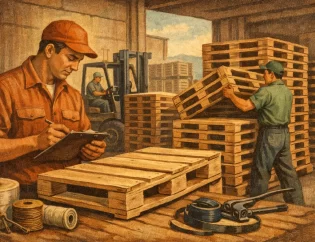
At a basic level, the service should remove excess pallets quickly and responsibly. But that should be the floor, not the ceiling. For commercial customers, the stronger model combines pallet pickup, pallet recycling, pallet resale, and supply support under one account.
That changes the conversation from disposal to pallet management. Instead of asking, “Who can haul these away?” your team can ask, “What is the best recovery path for this inventory, and how do we keep it from becoming a recurring issue?”
A good provider should be able to adapt by pallet type, volume, and condition. A small quantity of damaged mixed pallets is not the same as a steady stream of standard-size reusable units. The right program accounts for that. It should also support one-time cleanups and ongoing scheduled pickups, because what works for a single overflow event may not work for a high-volume shipping facility.
For larger organizations, reporting matters almost as much as removal. If your accounting team, operations managers, and sustainability leads all need different information, a tracked service model saves time. Centralized records help confirm pickups, monitor site activity, and document recycling outcomes without forcing local teams to build their own spreadsheets.
The problem with fragmented local pallet vendors
There is nothing inherently wrong with local pallet companies. In many cases, they serve an important role. The issue starts when a business with multiple sites tries to manage pallet recycling one market at a time.
One location may get reliable service, while another waits days longer than promised. One site may receive payment for reusable pallets, while another pays to move a similar load because standards are not aligned. Over time, those differences create confusion and cost leakage.
Internal teams end up spending time on vendor sourcing, follow-up calls, service disputes, and documentation gaps. That is time your warehouse and operations staff should be spending on shipping, receiving, inventory flow, and labor efficiency.
A national model reduces that friction. It creates a single point of accountability and a standard process for service requests, scheduling, and transaction tracking. For businesses trying to simplify vendor management, that is often the deciding factor.
How a centralized pallet program improves operations
The biggest operational gain is predictability. When pickups are scheduled through one provider, your sites do not have to solve the same problem over and over. Requests follow a known process. Pickup windows are easier to manage. The outcome is easier to verify.
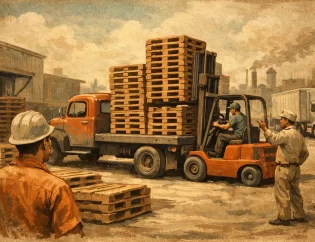
That predictability helps with space management. Excess pallets take up room that should be used for product movement, staging, or equipment access. They can also create avoidable safety concerns in busy dock and yard areas. A structured pickup program keeps those piles from building into a larger disruption.
There is also a procurement benefit. Businesses that both generate and buy pallets can work with a partner that understands both sides of the cycle. Recovered pallets can re-enter the market, and your supply needs can be supported through the same relationship. That does not mean every company needs a fully integrated pallet strategy, but for many, it reduces unnecessary purchasing and adds flexibility when demand shifts.
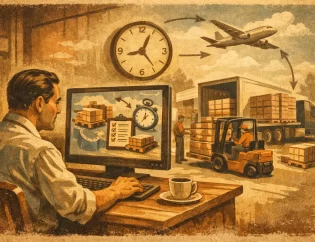
For multi-location businesses, online account visibility can make a major difference. Instead of chasing updates from each site, stakeholders can review transactions and service activity in one place. That is especially useful when pallet recycling is tied to broader cost control or environmental reporting goals.
National pallet recycling service and sustainability goals
Most businesses do not need marketing language around sustainability. They need practical results they can report and defend. A national pallet recycling service supports that by keeping pallets in circulation longer, separating reusable inventory from scrap, and reducing the amount of material sent into the waste stream.
That is good for the environment, but it also supports common business objectives. Companies are under pressure to reduce landfill use, improve waste diversion, and show measurable progress in operational sustainability. Pallet recovery is one of those areas where environmental responsibility and cost discipline can actually align.
It is worth being realistic, though. Not every pallet can be repaired or remarketed. Condition, size, contamination, and local demand all affect recovery options. A credible recycling partner should be clear about those trade-offs rather than promising maximum value on every load.
Choosing the right national pallet recycling service
The best fit depends on your volume, footprint, pallet mix, and internal resources. A single-site manufacturer with occasional overflow needs something different from a retailer managing pallet activity across dozens of locations. The service should match the complexity of your operation, not force your team into a generic program.
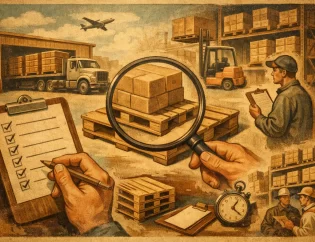
Look for a provider that can explain what happens at each step: request intake, pickup scheduling, pallet grading, recycling or resale handling, and transaction reporting. If the process is vague on the front end, it usually becomes harder to manage later.
Responsiveness also matters. Pallet accumulation tends to become urgent fast, especially when dock congestion or safety concerns are involved. A provider with national coverage should still be able to offer local execution that feels timely and practical.
Finally, consider whether the service helps your business do more than just clear space. The strongest partners reduce hauling pressure, recover value where possible, support pallet purchasing when needed, and give your team one less moving part to manage. That is where a company like Pallet Pickup stands apart – not simply by collecting pallets, but by offering a centralized model built for commercial operations.
When national coverage is the better choice
If your business has multiple facilities, variable pallet volumes, or recurring disposal issues, national coverage usually makes sense. It is also a strong fit for companies trying to standardize vendor relationships and improve reporting across sites.
For smaller businesses with one location and very low pallet volume, a local option may still be workable. But once pallets become a recurring operational issue, the hidden cost of fragmented service starts showing up in labor time, slow response, wasted space, and missed recovery value.
A national pallet recycling service is not just about scale for its own sake. It is about making pallet removal, recycling, and supply easier to manage as your business grows. When the service is structured well, it reduces internal effort while giving you better control over cost, timing, and environmental performance.
The best pallet program is the one your team does not have to keep chasing. If your sites are dealing with buildup, inconsistent service, or too many vendors, it may be time to treat pallet recycling as an operational system instead of a cleanup task.